
Everyday Risks 2026
Prove Protection Works
We understand that protection can feel abstract until your clients can see the difference it makes in real life.
We understand that protection can feel abstract until your clients can see the difference it makes in real life.
Throughout this guide, we’ve explored the financial pressures your clients face, the everyday risks that can affect their income, and life’s moments that make protection most relevant.
To bring these together, we now look at claims. By providing tangible evidence of protection in action, you can give your clients the relevant statistics and insights to demonstrate how cover can support their finances, plans, and the people who matter to them.
- Protection insurers paid out £7.84bn in individual and group protection claims in 2025
- 258,000 new individual protection claims were paid in 2025
- Average protection claim was £19,300 – up 2% on 2024
- 97.9% of protection claims were accepted
These statistics show your clients the valuable financial support protection provides to hundreds of thousands of individuals and families every year.

What do people claim for the most on their policies?
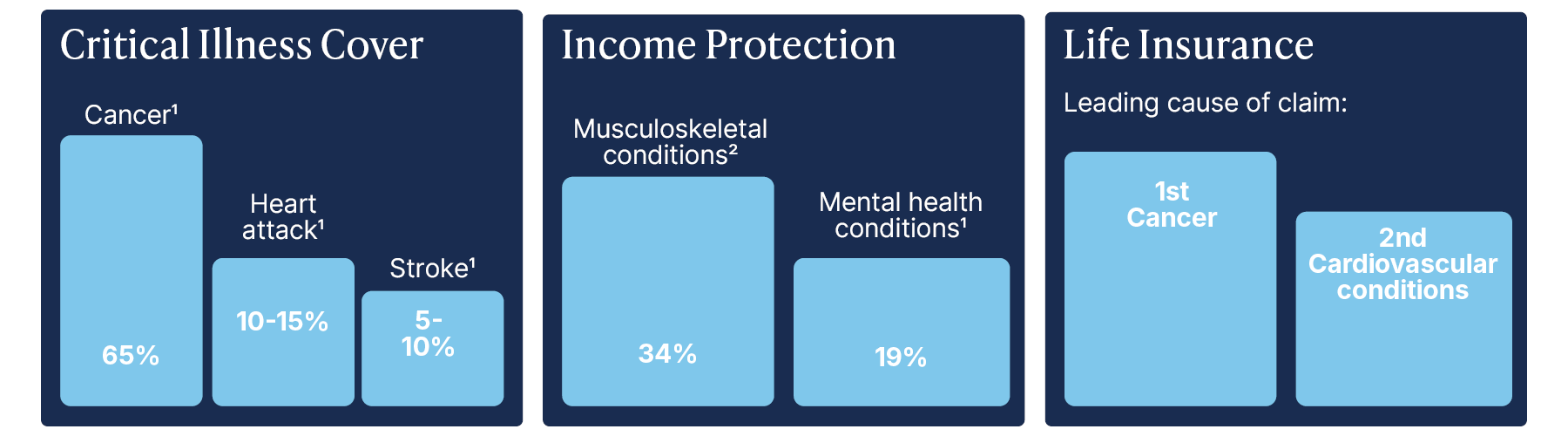
See the source for the above data.
While these types of protection support your clients if they suffer a serious illness or condition, accident and sickness products such as MetLife’s EverydayProtect see a high volume of claims for everyday accidents and illnesses that can disrupt someone’s life and their ability to earn a living.
Everyday protection in action: MetLife UK claims

Bundling protection products, such as a critical illness policy plus an accident and sickness policy, can provide your clients with a comprehensive financial safety net – giving them peace of mind that, whatever happens, they’re covered.
Claims case study: When protection is needed most
Protection adviser Jordan Galloway of JG Financial shared the following client story, highlighting the value of combining different protection solutions.
In November 2024, a client sought advice on protecting himself and his partner financially. He rented his home, received no employer sick pay and was a keen downhill mountain biker.
Following a protection review, he chose a combination of:
- Life Insurance
- Critical Illness Cover
- Income Protection with a four-week deferred period
- MetLife EverydayProtect with Active Lifestyle Cover
Less than two years later, he suffered a serious mountain biking accident, resulting in seven broken ribs, a ruptured spleen requiring emergency surgery and a six-night hospital stay.
MetLife EverydayProtect paid multiple benefits from the same incident:
- Loss of spleen: £15,000
- Seven broken ribs: £3,500
- Six nights in hospital: £600
Total claim paid: £19,100
The claim was approved and paid within days, providing immediate financial support while the client recovered. Because his Income Protection policy had a four-week deferred period, the EverydayProtect payment arrived before any Income Protection benefits were due, helping to ease financial worries for both him and his partner.
Reflecting on the claim, Jordan said:
How to use claims data to build client confidence in protection
Claims data shows the product works. The facts and figures highlight the relevance of cover and bust the myth that insurers don’t pay. Sharing this insight with your clients – whether it’s how much the insurance industry paid out or how many MetLife UK customers claim for a broken bone or a sick child – gives them the confidence to take out cover.
You can use claims statistics to move the conversation from theory to reality.
You can then personalise the conversation.
Clarity gives your clients confidence in protection
Claims data is powerful, but MetLife’s YouGov research found that the most persuasive proof point may be clarity rather than claims volume alone.
When asked what would make them feel most confident that protection insurance could be useful in real life, 41% of UK adults selected understanding exactly what is and is not covered.
This was far ahead of knowing how quickly claims are paid at 13%, knowing the average payout amount at 12%, knowing the proportion of claims paid at 12%, and seeing examples of everyday claims people made at 12%.
This does not reduce the value of claims statistics; it changes how they should be used. Lead with clarity - what the policy covers, what it does not cover, when it pays, and how the benefit works - then use claims data and case studies as evidence that the cover can work in real life.
Claims data turns protection into something your clients can see and understand. By sharing examples of claims and the amounts that are paid out, you help make cover relevant to your clients and demonstrate how protection can support their finances and what matters to them.
Together with the insights and guidance throughout this guide, these examples can help you build better protection conversations.
Closing words
At the IPTF – Income Protection Task Force – our goal is to support activity and projects to reduce the protection gap and ensure more people have the financial resilience to cope when the unexpected happens. This guide brings that goal to life. It shows, in clear and compelling terms, that protection isn't just about the catastrophic; it's about the everyday: a broken bone, a hospital stay, a child off school, a few weeks without pay.
What strikes me most is how attainable these conversations are. Advisers don't need to rely on worst-case scenarios to make protection relevant. The data here shows that ordinary life, illness, injury, financial pressure, is reason enough. Our own research through the IPTF Adviser Voice reports consistently tells us that when advisers have the right tools and confidence, clients respond. This guide is one more tool in that armoury.
Together, we can help reduce the protection gap, one conversation at a time.
Vicky Churcher
Executive Director, IPTF