
Everyday Risk Report
Make everyday risk real
One of the challenges you may face is helping your clients recognise the potential health risks in their own lives.
Many people are resolute that a serious illness or life-changing injury simply won’t happen to them. But, when it comes to disrupting household income, it takes a lot less than a serious condition to put the household finances under pressure.
An everyday condition such as a broken bone, back pain or stress can significantly restrict a client’s ability to work and pay the bills. A broken ankle usually takes six to eight weeks to heal, while a bad back could put someone out of action for months.
Even a seemingly minor injury such as a broken finger might require weeks off work if it means your client is unable to drive, use machinery or use a computer.
Better protection conversations begin by making risk relatable. By connecting everyday risk to their potential financial impact, you can make the role of protection easier for your clients to understand.

Everyday health risks
Statistics show that these everyday conditions and injuries are not just common but that the risk of needing time off work due to health issues is increasing:
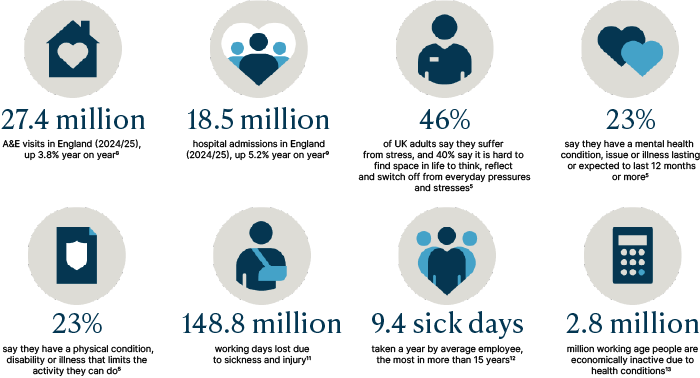
National data shows the scale of A&E visits, hospital admissions, and sickness absence, but MetLife’s YouGov research makes the statistics feel more applicable to your clients.
In the past 12 months, 23% of UK adults say they or someone in their household had an A&E visit, 15% experienced an overnight hospital stay, 11% experienced illness or injury causing up to two weeks off work, and 12% experienced illness or injury causing more than two weeks off work.
These findings bring everyday risk closer to home. Clients may not see themselves as likely to experience a major illness or life-changing injury, but the YouGov findings show that household disruption from A&E visits, hospital stays, and shorter periods off work is already part of many people’s lives.
Using the data to make risk more relatable
These statistics help you move the conversation away from distant, remote possibility and towards more relevant situations your clients can recognise in their own lives.
Replace unlikely events with everyday reality
Data can help clients understand the risk.
“In the last year alone, there were over 27 million visits to A&E and 18.5 million hospital admissions. Many of these were for common, everyday health issues.”
Show that hospitalisation is possible, not remote
The statistics highlight the range of reasons for hospitalisation, from serious diseases to minor injuries and conditions.
“A large proportion of hospital admissions are for common issues like digestive problems, fractures and injuries, not just major illnesses.”
Link health to income disruption
Demonstrate that time off work due to health issues is common and on the rise.
“Across the UK, nearly 149 million working days are lost due to sickness each year. If you had to take time off, how would this affect your income?”
Introduce protection for everyday health risks
The statistics are a great opportunity to change clients’ perception of protection.
“Protection isn’t just about the serious stuff. There are policies that provide financial support if you’re injured or need to spend time in hospital.”
MetLife’s YouGov data suggests you may need to reset how your clients think about protection. When asked what type of event they most associate with financial protection insurance, the leading answer was long-term inability to work, selected by 23%.
By contrast, only 8% associated protection with short-term illness or injury causing time off work, 3% with an accident or broken bone, and 2% with hospital stays.
This protection gap matters because many everyday events that can disrupt income are not the events people naturally connect with protection. For better conversations, you need to broaden your client’s frame: protection should be about the ordinary disruptions as well as the catastrophic ones.
“Many people think protection is mainly about death, critical illness, or long-term inability to work. But recent YouGov research found that nearly a quarter of UK adults had someone in their household visit A&E in the past year, and more than one in ten had illness or injury causing more than two weeks off work. Would your finances be prepared for that kind of disruption?”