
Everyday Risk Report
Starting with the Protection Gap
Protection is rarely at the top of your clients’ financial to-do list. With more immediate priorities, such as sorting the mortgage or topping up their pension, protection can feel irrelevant, which can make it challenging to start a meaningful conversation.
But, without protection, even the most carefully considered financial plans are at risk of being undermined. Losing a month’s income due to sickness, or having to take time away from work to look after a child in hospital could make it difficult to cover the monthly mortgage repayment or keep pension plans on track.
Better protection conversations start with what already matters to your clients. By connecting protection to your clients’ goals and aspirations—and to the financial resilience required to keep them on track—you can make its value more relevant. Yet, as the data in this section demonstrates, many people are still unaware of the role that protection can play.

The protection gap
More than half of UK adults have no protection insurance in place, with our research showing that ownership of specific protection products is even lower: 28% have life insurance, 11% have critical illness cover, 6% have income protection, and 7% have accident/sickness/hospital cash cover.
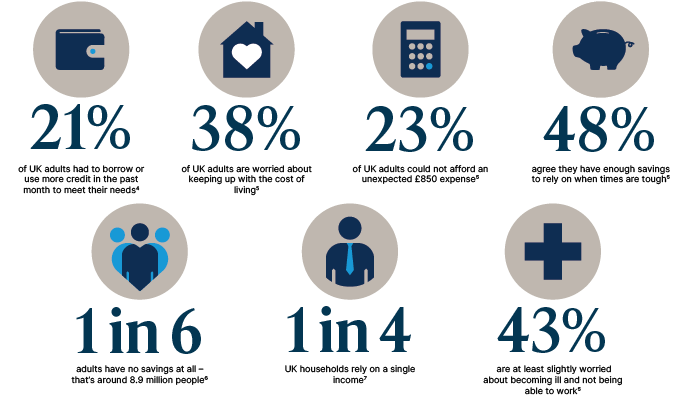
Our research also found that many households have limited room for manoeuvre if income is interrupted.
When asked to imagine their household’s main earner being unable to work for six weeks because of illness or injury, 26% of UK adults say they’re not confident their household could keep up with regular living costs without borrowing money.
The coping behaviour is also revealing. If household income reduced significantly for six weeks because of illness or injury, 32% say they would rely first on savings, 17% on employer sick pay, and 14% on cutting back spending.
Only 1% say they would rely first on an insurance payout, showing that insurance is not yet front of mind as an everyday financial resilience tool.
Given these findings, it’s time to push protection up the priority list.
Turning insight into conversation
The data in this guide can help you introduce the concept of protection naturally into your advice process. Rather than leading with product, real world data can help prompt clients to evaluate the potential impact of not having cover in place.
Normalise the conversation
Start with the wider environment. National data removes any sense that their financial situation or protection are in any way unusual or optional.
“A lot of people are feeling financial pressures now. In fact, recent figures show that around one in five people have needed to borrow to cover everyday living expenses.”
Highlight financial fragility without being alarmist
Statistics can illustrate real-world pressures and show a client they’re not alone.
“Nearly a quarter of adults say they wouldn’t be able to cover an unexpected bill of £850. Have you considered what you would do if you were hit with this sudden cost?”
Introduce income dependency risk
Bring it into the household. Facts and figures can help clients understand vulnerabilities in their own financial situation.
“Around 1 in 4 households in the UK rely on one income. How would you keep up with the bills if you were unable to work due to an accident or sickness?”
Use the six-week income shock test
Moving from broad financial pressures to a specific household scenario can make protection more relevant.
“A quarter of UK adults aren’t confident they could manage for six weeks without borrowing. What would happen if the main earner in your household was unable to work for six weeks?”
Set the stage for protection
Once a client understands the weak spots in their financial situation, introducing protection solutions makes sense.
We understand that better protection conversations don’t start with products, but with real life and its unexpected financial and health curveballs.
By using relevant, everyday data, protection conversations feel more natural, helping your clients recognise the importance and value of having a better plan in place.
Adviser top tips
Explore more sections
[4] UK Parliament (2026) High cost of living: Impact on households, High cost of living: Impact on households - House of Commons Library
[5] Kantar Monitor 2026 Data
[6] Finder (2026) Savings Statistics: Average UK Savings in 2026, Savingsstatistics: Average UK savings in 2026
[7] ONS (2026) Working and workless households in the UK: October to December 2024, Working and workless households in the UK - Office for National Statistics